Wednesday, May 16, 2012

Feedback 16-05-2012

Work

Below is my planning from my last post with comments.
  1. Investigate why the IRTI line horizontal at the end of the Six Hump Camel Back Experiments.
    1. The maximum tree depth was not the cause
    2. It was caused due to the fact that the values get really close together at some point and the exploration value is not able to "fix" random bad choices (at least not within a reasonable number of sampels)
  2. Implement a visualization to show at which time a split occurs (at which sample number). 
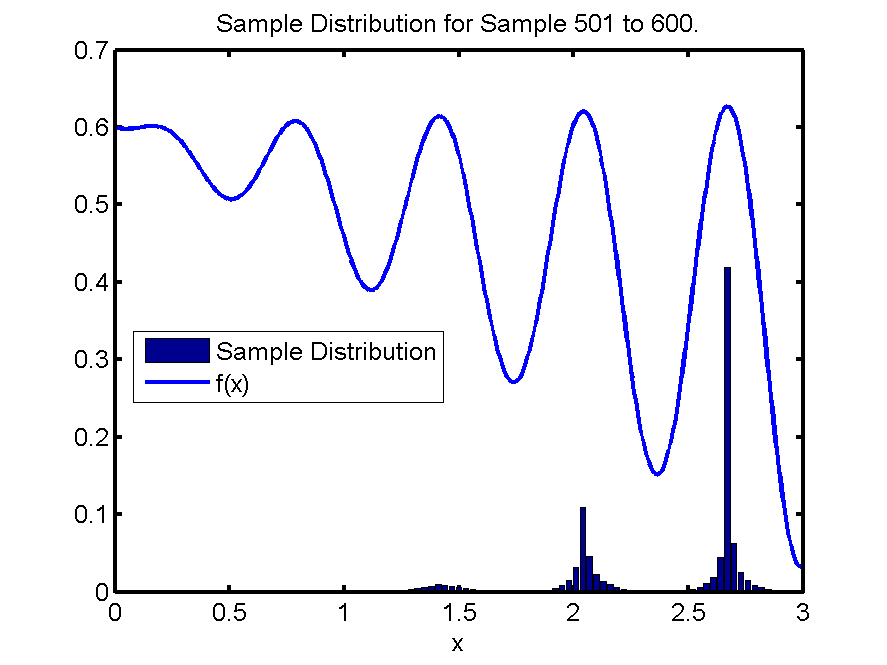
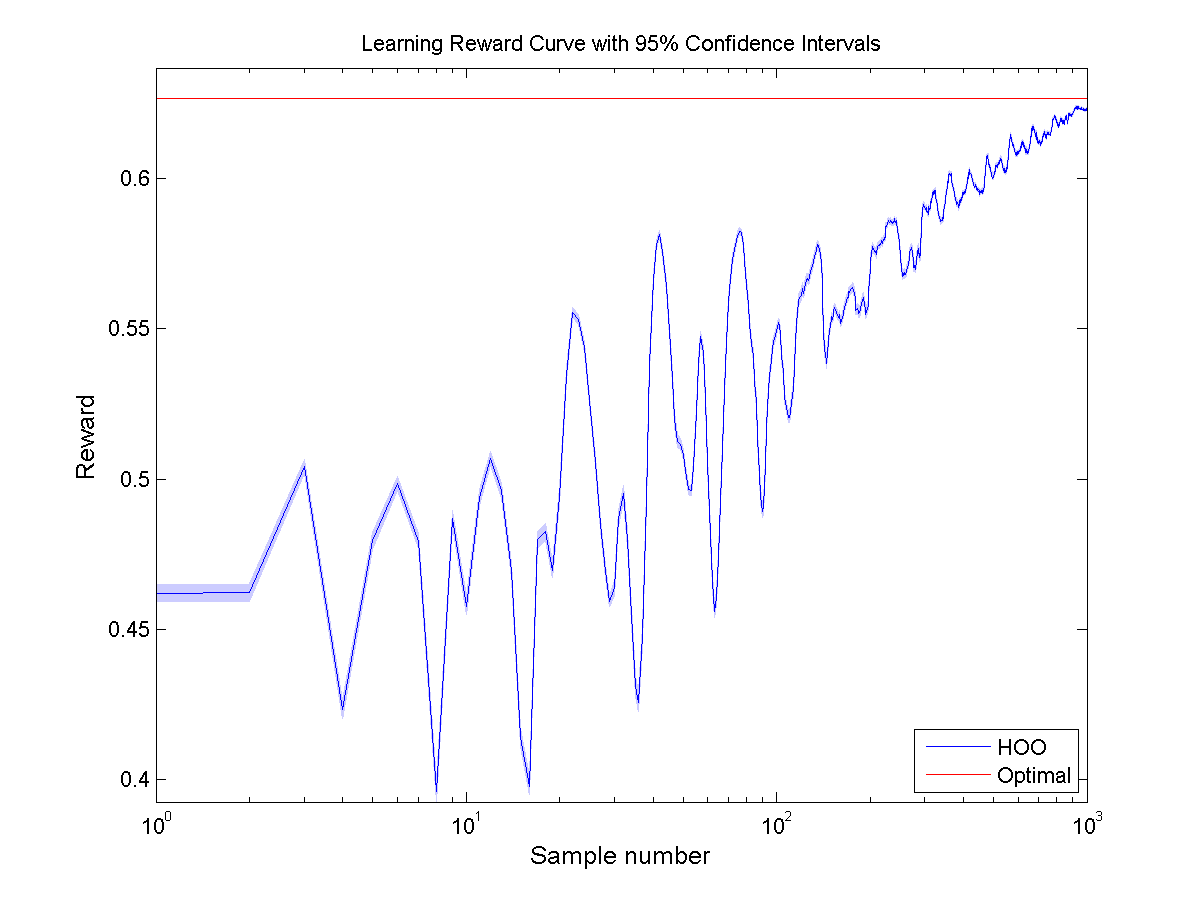
    1. See the two posts with the results of the Sinus and Six Hump Camel Back environment
    2. The "1-dimensional heatmap" or "vector or colors" representation did not look so nice as the graph representation
  3. Check if it is correct that the RMTL agent has a significant decrease in number of simulations per second when memorization is enabled, as seen in the table of the last post.
    1. This is correct
  4. Think which parameters are relevant (to mention in the report) and remove the redundant.
    1. The posts with the Sinus and Six Hump results are edited and now only show a reduced amount of relevent parameters
  5. Optimize the multi-step agents
    1. Been tweaking the  multi-step agents a lot
  6. Think of a graph representation of the multi-step experiments and rerun them under more difficult settings, i.e. less time or the settings from the paper (with noisy rewards, noisy actions, etc).
    1. I tried a different setting for the CartPole which is a bit more difficult [1]
    2. I found out that Vanilla MC is really good and outperforms all the other algorithms; it can balance perfectly each time given only 50ms per step. The reason is because it can achieve a high number of simulations. 
    3. I saw that for greedy pick I used the best sample found and not the best sample of the leaf with the best mean (for the results of the post from 02-05). In the first case, the agent is comparible with the Vanilla agent and performs pretty well while in the latter case, the agent performs worse and is not able to achieve enough simulations for an accurate approximation.
    4. The Donut World environment has the property/flaw that optimizing (only) the next step is sufficient and no future planning is actually needed.
  7. Implement perfect recall on meta tree level
    1. Implemented a way that multi-step action sequences with reward sequences are stored and "replayed" whenever a split occurres, as discussed with Lukas and Andreas. It seems the agents perform better with this option.
  8. Furthermore, I've been writing on the report.
Planning
  1. Report writing
  2. Work on multi-step agents and experiments
  3. Implement Transposition Tree

[1] H. Van Hasseld and M.A. Wiering, "Using Continuous Action Spaces to Solve Discrete Problems".

Wednesday, May 2, 2012

Meeting 02-05-2012

Discussion Points

Andreas, Lukas and me presented the results of the experiments (see previous posts for my results). I've got some usefull feedback and comment, which are summarized in the planning below.

Planning

  1. Investigate why the IRTI line horizontal at the end of the Six Hump Camel Back Experiments.
  2. Implement a visualization to show at which time a split occurs (at which sample number). 
  3. Check if it is correct that the RMTL agent has a significant decrease in number of simulations per second when memorization is enabled, as seen in the table of the last post.
  4. Think which parameters are relevant (to mention in the report) and remove the redundant.
  5. Optimize the multi-step agents
  6. Think of a graph representation of the multi-step experiments and rerun them under more difficult settings, i.e. less time or the settings from the paper (with noisy rewards, noisy actions, etc).
  7. Implement perfect recall on meta tree level
  8. Implement Transposition Tree

Feedback 02-05-2012

Multi-step Results

I've ran some experiments regarding the four multi-step algorithms in the CartPole environment:

- I used pretty "easy" settings for the environment (no transition/reward/observation noise, a small but sufficient action space (force applied to the cart), etc.).
- On the other hand, I limited the agent to (only) 100 ms per step.
- The rewards are equal to the number of steps the agent is able to balance the pole.
- Per algorithm, 100 runs were performed.
- Note that I did not improve/profile the agents yet and neither did I tune the parameters in detail. Furthermore, I could only do 100 runs due to time constraints of today's meeting. Therefore, the results have to be considered preliminary.

algorithm  |  reward
<= 100
> 100
> 250
> 500
>= 1000
RMTL
0
0
0
1
99
RSTL
2
2
3
3
90
HOSTL
2
2
3
8
85
HOMTL
0
0
0
0
100

- The next table shows the number of simulations each algorithm can perform in 1 second (roughly; on average) during the first 10 steps in the CartPole environment.

algorithm   |   avg sims/s
Memorization
No memorization
RMTL
37000
39000
RSTL
18000
32000
HOSTL
7300
7700
HOMTL
5000
5000


Thesis Overview


Friday, April 27, 2012

Feedback 27-04-2012


Experiment Results

I also ran experiments in the Six Hump Camel Back environment. Again, all experiments are done over 1000 samples and are averaged over 1000 runs. For every experiment the 95% confidence intervals are displayed by a colored region surrounding the lines.

Incremental Regression Tree Induction (IRTI)
  • MCTS_C = (parentRangeSize / globalRewardVolume) * Config.MCTS_K
  • MCTS_K=1.0
  • IRTI_SPLIT_NR_TESTS=100
  • IRTI_SPLIT_MIN_NR_SAMPLES=75
  • IRTI_SIGNIFICANCE_LEVEL=0.001
  • IRTI_MEMORIZATION = true


Hierarchical Optimistic Optimization (HOO)
  • MCTS_C = (parentActionSpaceVolume / globalActionSpaceVolume) * globalRewardVolume * MCTS_K)
  • MCTS_K=0.5
  • HOO_V_1 = (sqrt(nrActionDimensions) / 2) ^ HOO_ALPHA
  • HOO_RHO = 2 ^ (- HOO_ALPHA /  nrActionDimensions)
  • HOO_ALPHA=0.99
  • HOO_MEMORIZATION = true

IRTI + HOO +  MC + Random + UCT (pre-discretization with 2 splits per depth)


Planning
  1. Run experiments regarding the multi-step agents and possibly debug / optimize code.

Sunday, April 22, 2012

Feedback 22-04-2012

Experiment Results

Finally some nice results to show after some debugging and parameter tuning; manual and    automatic. All experiments are done over 1,000 samples and are averaged over 10,000 runs. For every experiment the 95% confidence intervals are displayed by a colored region surrounding the lines.

Incremental Regression Tree Induction (IRTI)
  • MCTS_C = (childRewardRangeSize / globalRewardRangeSize) * MCTS_K)
  • MCTS_K = 2.0
  • IRTI_SPLIT_NR_TESTS = 100
  • IRTI_SPLIT_MIN_NR_SAMPLES = 50
  • IRTI_SIGNIFICANCE_LEVEL = 0.001
  • IRTI_MEMORIZATION = true


Hierarchical Optimistic Optimization (HOO)
  • MCTS_C  = (parentActionSpaceVolume / globalActionSpaceVolume) * globalRewardVolume * MCTS_K
  • MCTS_K=5.0
  • HOO_MEMORIZATION = true
  • HOO_V_1 = (sqrt(nrActionDimensions) / 2) ^ HOO_ALPHA 
  • HOO_RHO = 2 ^ (- HOO_ALPHA /  nrActionDimensions)
  • HOO_ALPHA = 0.99

IRTI + HOO +  MC + Random  + UCT (pre-discretization with 25 splits per depth)


Work

Implemented all four multi-step agents and seem to be able to balance the pole in the Cartpole environment pretty well.
    1. Regression-based Meta Tree Learning agent (RMTL)
    2. Hierarchical Optimistic Meta Tree Learning agent (HOMTL)
    3. Regression-based Sequence Tree Learning agent (RSTL)
    4. Hierarchical Optimistic Sequence Tree Learning agent (HOSTL)
Planning
  1. Find a better parameter set for HOO for the Six Hump Camel Back function as it is now barely better than UCT with pre-discretization in that environment. I can then generate the same pictures as the ones above.
  2. Do experiments regarding the multi-step agents and possibly debug / optimize code.

Saturday, April 14, 2012

Meeting 12-04-2012

Work
  1. Fixing, debugging and improving IRTI and HOO. 
  2. Furthermore, a lot of parameter tuning for above two algorithms.
Action Points
  1. Michael and I had a discussion about the exploration factor
    1. C should be related to the reward range
      1. constant C =  globalRangeSize * K
      2. adaptive C =  parentRangeSize * K
      3. Lukas proposed: adaptive C = (childRangeSize / globalRangeSize) * K
    2. For HOO, you should also multiply the last term (diam) with C or divide the first term (mean reward) with C.
      1. R + C * exploration + C * diam 
      2. R / C + exploration + diam
Planning
  • Change the HOO formula (see action points)
  • Generate reward distributions (learning curve, greedy curve, error) of several algorithms
    • IRTI
    • HOO
    • UCT (pre-discretization)
    • Vanilla MC (random sampling, greedy returns best sample seen)
    • Random
  • I should ask Lukas about the working of his IRTI algorithm to find out why mine does not converge samling at the global maximum.

Friday, April 6, 2012

Feedback 06-04-2012

Work
  1. Looked into sample Scala code for parameters used for the experiments of the TLS paper. Unfortunately I wasn't able to generate the same results yet. From the code, it seems following settings are used:
    1. Non-Adaptive C of 0.5
    2. T-test
    3. minNbSamples = 25
    4. minNbSamplesPerPopulation = 5
    5. significanceThreshold = 0.001
  2. Following 4 points are some experiments performed of Regression Trees / HOO in combination with constant / adaptive C in the Sinus experiment (averaged over 1000 tests).
  3. Regression Trees with constant C (= 0.5 *  totalRewardRangeSize)


    1. Regression Trees with adaptive C (= 0.5 *  parentRewardRangeSize) 


    2. HOO with constant C (= 0.5 * totalRewardRangeSize) 


    3. HOO with adaptive C (= 0.5 * parentRewardRangeSize) 


    4. Regression trees is not able to sample at the global maximum (as of now). It does not explore and split properly to find the best region.
    5. HOO does a much better job than regression trees in the sinus environment and finds the global maximum most of the time.
    6. Although an adaptive c constant causes to focus more on the promising regions, it also causes the algorithm to get stuck in local maxima sometimes. Therefore, over multiple tests, the error is lower for HOO with adaptive c.